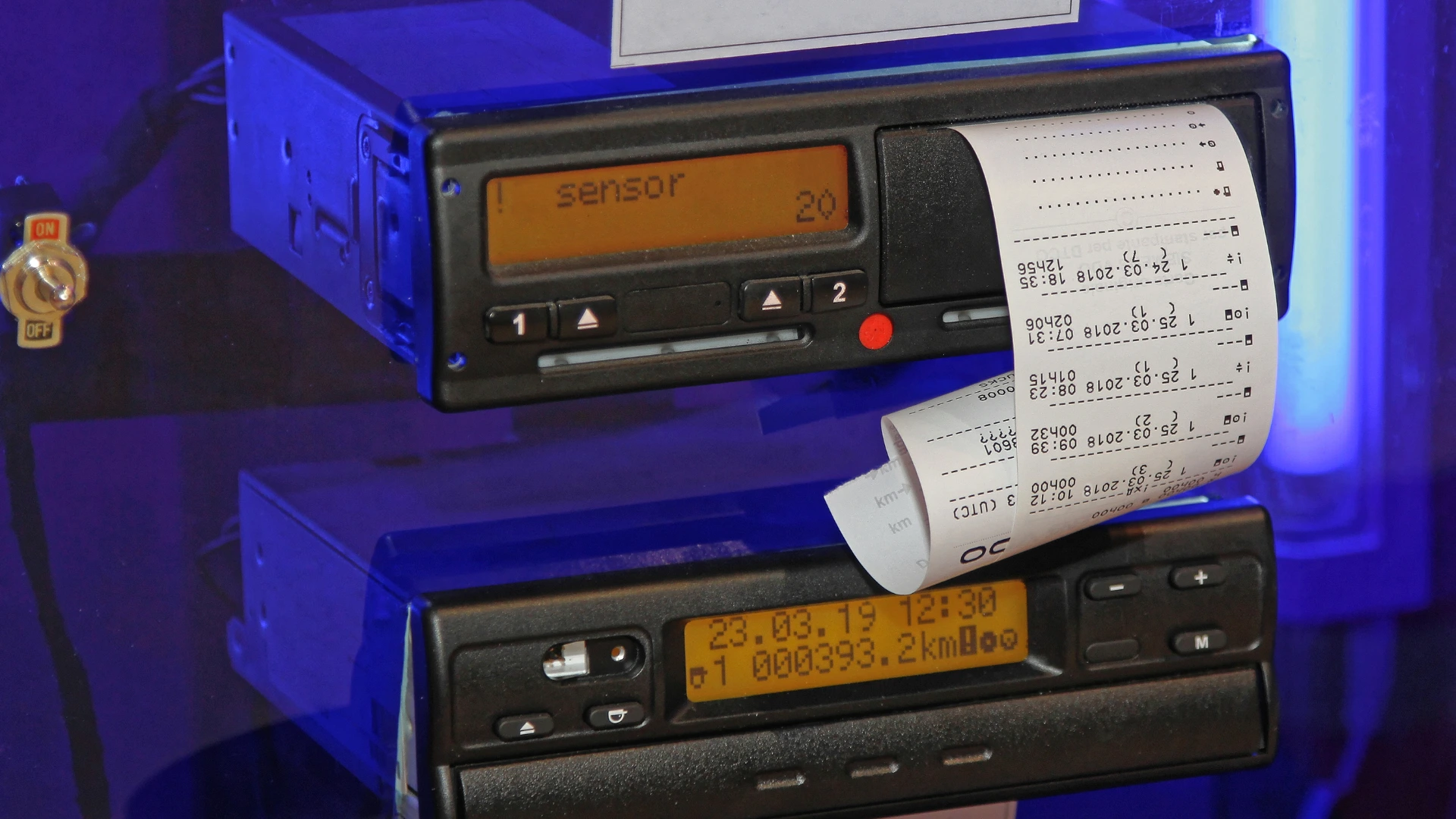
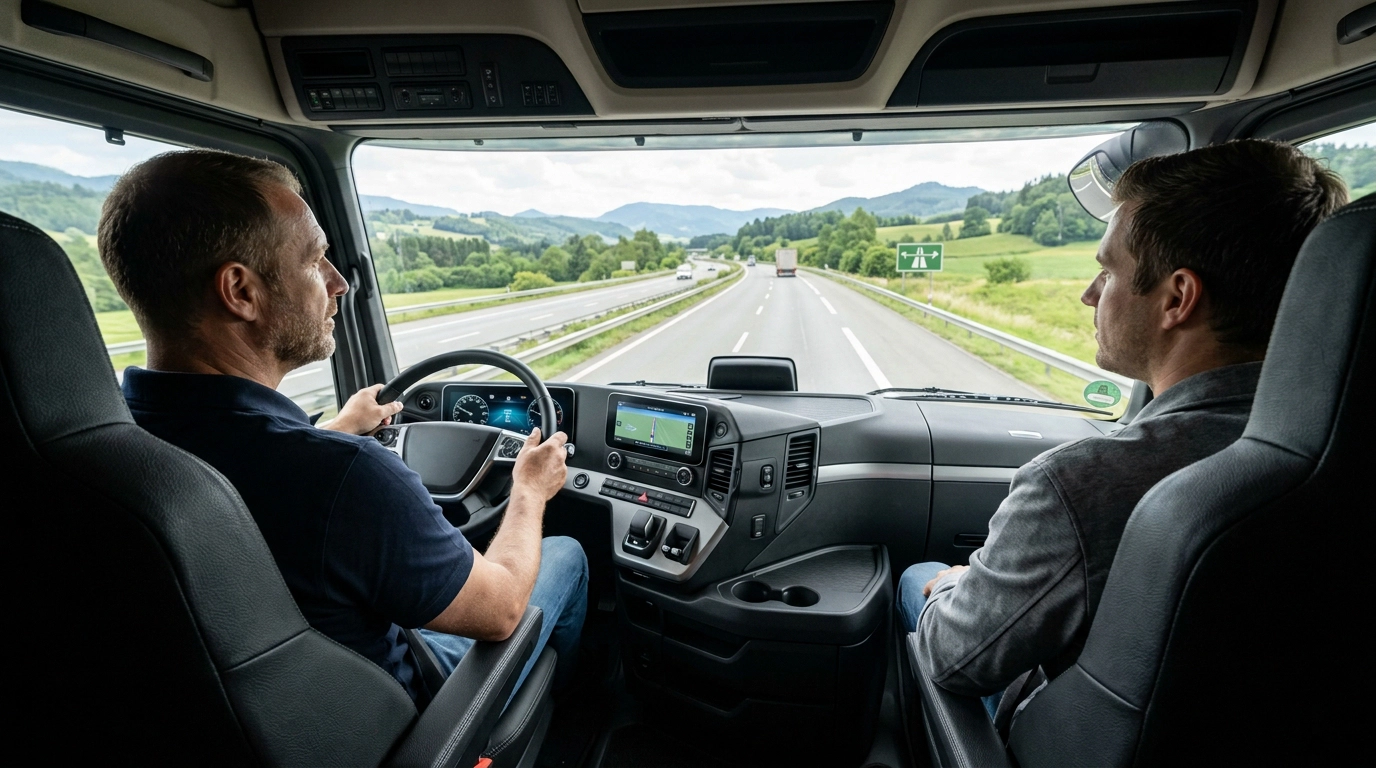
Border crossing recording in the tachograph occurs automatically only on second-generation devices—Smart Tacho 2 (G2V2)—equipped with a GNSS satellite module supporting the Galileo system. On all other tachographs (analog, digital G1, and first-generation smart tachographs G2V1), the driver is required to stop at the nearest available parking area immediately after crossing the border and enter the country symbol manually. According to current European Commission clarifications, even with Smart Tacho 2, the driver is obliged to visually verify the entry and manually enter the country if a satellite signal failure has occurred.
Since February 2022, as part of the European Mobility Package, a strict requirement came into force: every crossing of an internal border between EU countries must be recorded in the tachograph memory and on the driver’s chip card (Article 34(7) of EU Regulation No. 165/2014).
This requirement was not introduced arbitrarily. For enforcement authorities (Germany’s BALM, Poland’s ITD, France’s DREAL), border entries are the primary verification tool for:
The absence of a country symbol on the chip card when crossing a border is treated by inspectors as a serious violation. Fines range from €150–250 in Poland to €500–1,000 in Germany and France.
Confusion among drivers arises because trucks with devices of different generations are currently traveling on European roads simultaneously. Many mistakenly believe: “If I have a digital tachograph with a screen, it’s smart and does everything itself.” This misconception leads to massive fines.
Let’s examine each generation of devices:
1) Analog (“discs”) and first-generation digital tachographs (G1)
2) First-generation smart tachographs (Smart Tacho 1 / G2V1)
Production period: Installed on new trucks from June 15, 2019, to August 20, 2023.
In professional circles, a debate persisted for a long time: if Smart Tacho 2 is installed in the vehicle, is the driver relieved of all responsibility for the border crossing entry?
In official clarifications, the European Commission emphasized the principle of “duty of care”:
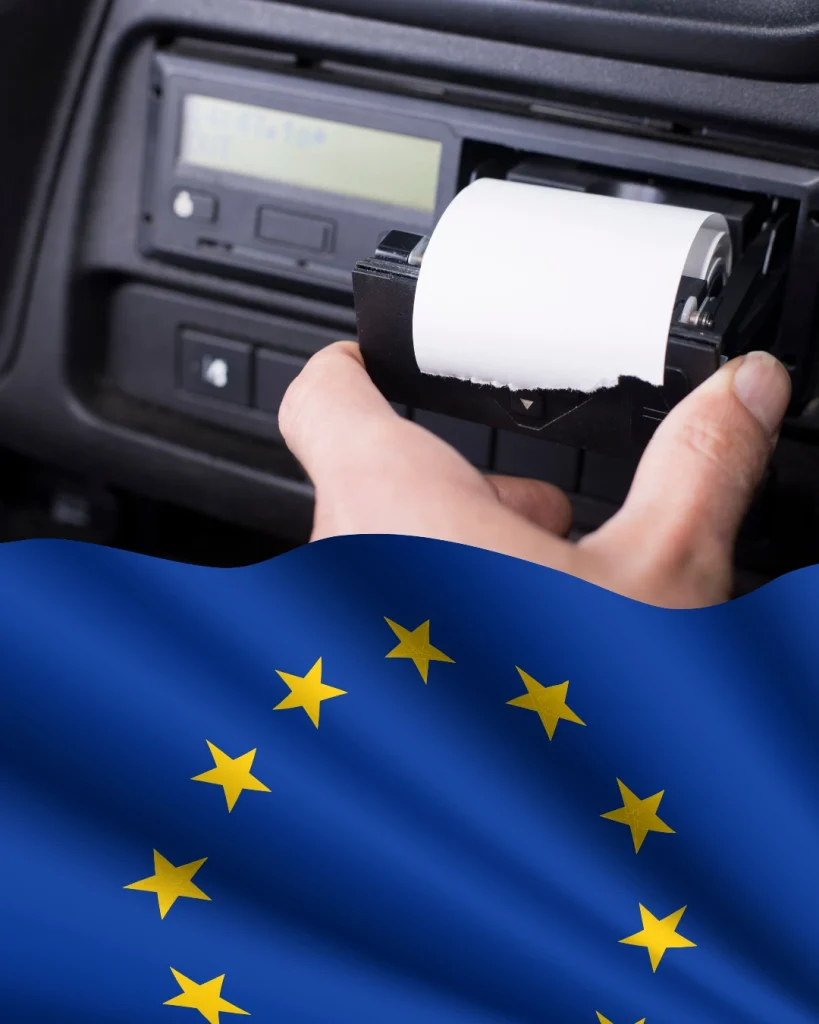
If your truck is equipped with a G1 tachograph or Smart Tacho 1 (G2V1), you are required to follow a strict action algorithm.
Where to stop?
The law states: the driver is required to make the entry at the “first possible stopping place at or immediately after the border” (najbliższe możliwe miejsce postoju).
How to enter the country via the menu (using VDO and Stoneridge as examples):
Important observation from practice: Never use the “Country of End” (Kraj zakończenia) item when crossing a border within a single work shift. “Country of End” is entered only when you complete your working day and begin daily or weekly rest.
This is a typical stressful situation on European highways, especially at the borders of Germany and Belgium in the evening. You crossed the border, pull into the first parking area, and there is not a single free space.
Procedure to protect yourself from a fine:
Example wording: “Art. 12 Reg. 561/2006. No parking space available at the first rest area after crossing the border. Driven to the next safe parking to register the country symbol”.
Add the date, time, signature, and attach the receipt to your working document folder. This will serve as a strong argument during an inspection.
Working with trainees, we at the training center regularly analyze fine reports. Here are typical mistakes drivers make:
Newcomers rarely consider that proper border recording directly affects their immigration matters. However, in the European Union, transport and border databases are closely integrated.
Legal work as a driver in Poland is based on strict compliance with the law. If a driver systematically ignores border entries, the transport company receives notices for violating cabotage rules. Loss of the company’s reputation as a reliable carrier (ERRU) can lead to suspension of the transport license. If the company loses its license, the foreigner loses the basis for work, and his residence card for driver work is revoked.
Moreover, unpaid fines for transport rule violations issued personally to the driver by BALM or ITD inspections may appear during border control. This creates difficulties when crossing the EU’s external borders.

Understanding all generations of digital devices and the nuances of European regulations solely through articles or videos is impossible. In a critical situation at the border, the driver becomes confused, presses the wrong buttons, and incurs fines.
At the “Code 95 with Mark” driving school and training center, we train drivers on real devices:
We prepare professionals who feel confident from day one of their assignment in front of any European inspector.
The rule for recording border crossings in the tachograph does not tolerate negligence. Automatic recording works only on vehicles with Smart Tacho 2, but even there the driver is required to monitor the system. If your truck is equipped with a previous-generation device, stopping at the first available parking area and manually entering the country symbol is your direct legal obligation.
Follow the driving and rest time regulations, treat the tachograph as the primary financial controller in the cab, and choose quality training. Enroll in courses at the StarTruck training center (“Code 95 with Mark”) to gain current practical knowledge and confidently build a career in European logistics.
The most reliable method is to open the technical data printout menu or look at the label on the edge of the housing (if the device is accessible). On Smart Tacho 2 screens (e.g., VDO DTCO 4.1), the start display shows a satellite icon or a small globe icon next to the time, and the entry menu includes a separate line “Loading/Unloading” (Załadunek/Rozładunek), which was not present in Smart Tacho 1.
Yes. When entering the territory of a new country on a ferry or train, the driver is required to enter the new country symbol. If you have Smart Tacho 2, the system will record this automatically via GPS after disembarking from the vessel, but if the device is a previous version, the entry country symbol is entered manually at the first stop after leaving the port.
Show the inspector the tachograph calibration certificate and the vehicle technical data printout confirming that the truck is equipped with a Smart Tacho 2 (G2V2) generation device. In these devices, recording is a standard automatic function. If there were no communication failures, the border data is contained in the device’s internal memory, to which the inspector has direct access via the diagnostic port.
The law does not set a limit in minutes—it operates on the concept of “first available safe stopping place.” If the first parking area is 2 kilometers from the border, you are required to pull in there and make the entry within a few minutes of stopping. Driving further when spaces are available at the first stop is classified as a violation.
Follow us on social media
[qsm quiz=”1″]