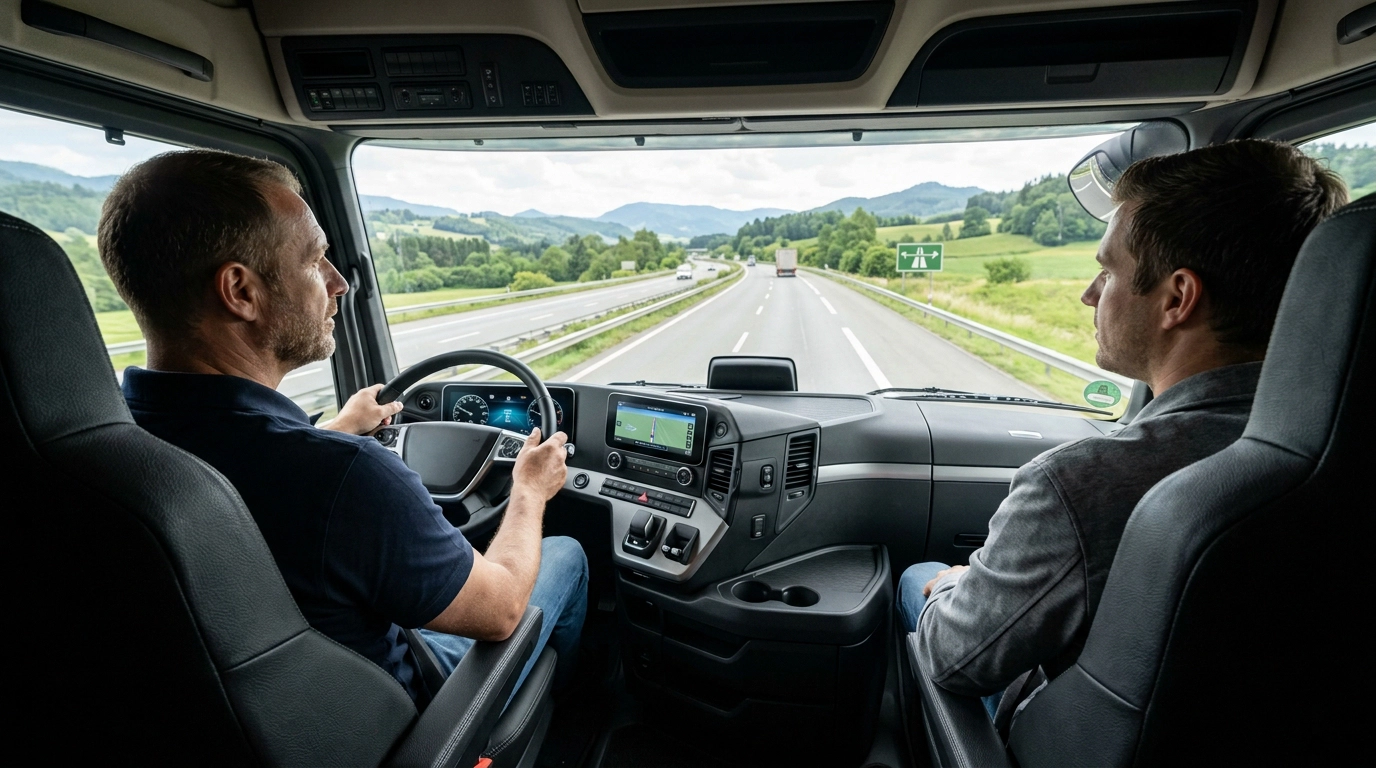
A two-driver crew (two-driver regime) is a work format where two long-haul truck drivers operate one truck in shifts within a 30-hour working period. According to European driving and rest time regulations, the maximum combined shift time is 21 hours, after which both drivers must take an uninterrupted rest of at least 9 hours in a parked vehicle. Correct use of the Tachograph (swapping smart cards in slots with each change of seats) and knowledge of exceptions allow the crew to legally expedite cargo delivery and avoid multi-thousand fines from transport inspections.
In European logistics, delivery speed is often critical. Perishable goods, expensive auto parts for assembly lines, or high-value electronics cannot sit in parking lots for 11 hours every night. For such trips, Transport companies use the two-driver regime (two-driver crew).
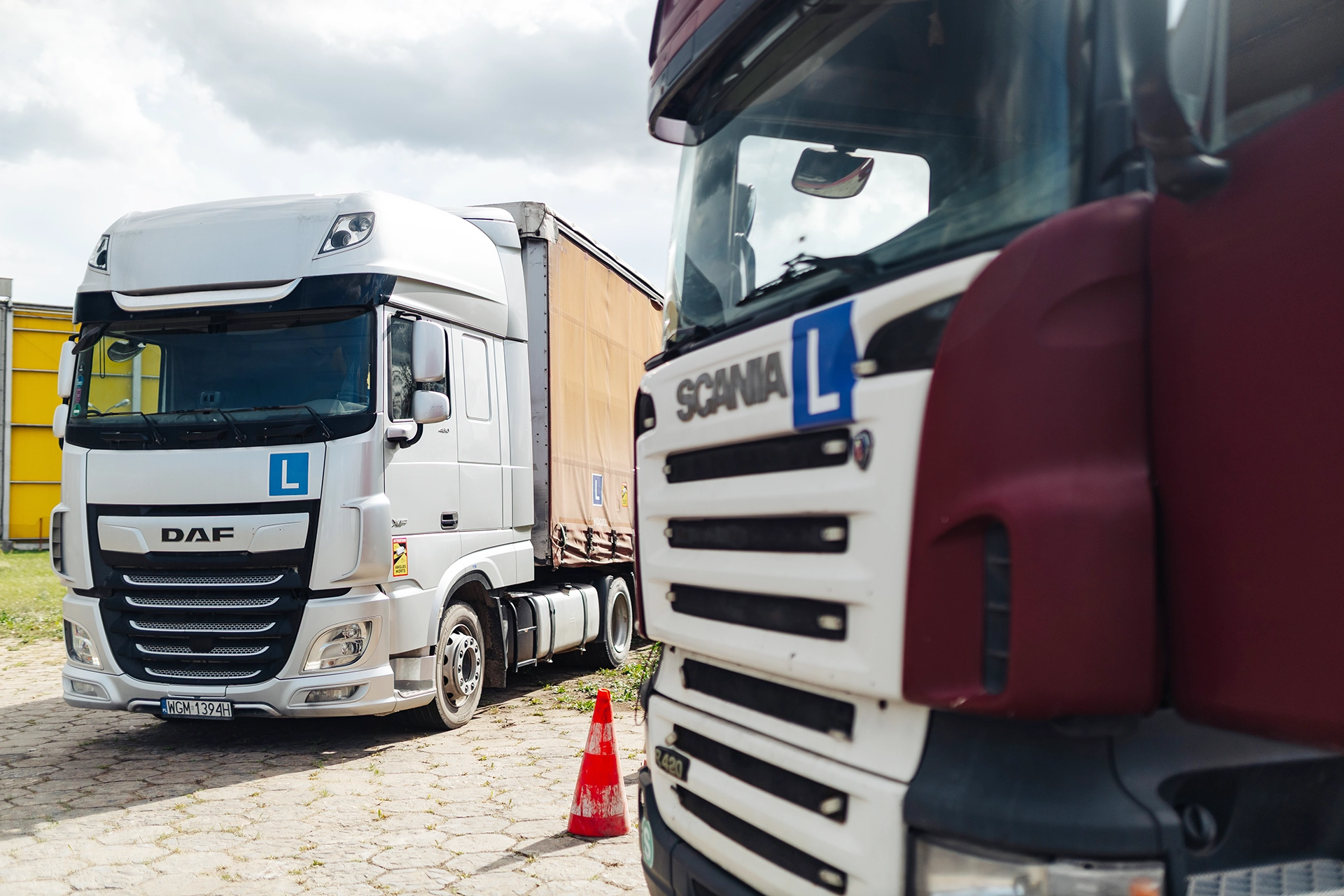
However, for newcomers whose driver job in Poland is just beginning, a two-driver crew is primarily a mandatory internship. Before entrusting you with a 40-ton truck, an experienced mentor will drive with you, teaching the nuances of maneuvering, cargo securing, and communication during loading.
The problem is that the rules for using the Tachograph in a two-driver trip differ fundamentally from solo driving. In this article, as expert practitioners, we will analyze two driver crew rules, show how to correctly switch slots, and explain which errors most often lead to sanctions from BAG/BALM and ITD.
The main difference between a two-driver crew and a solo driver lies in the calculated working period. While a solo driver operates within a 24-hour window, for a two-person crew, this period is extended to 30 hours.
How the Shift Mathematics Works:
This is the maximum time during which the truck can be in motion or the crew can perform other work.
Driving limits remain standard: each driver is allowed to operate the tractor for 9 hours (or 10 hours twice a week). This means the truck can collectively drive for 18 hours (or 20 hours if both use the extension). The remaining time out of 21 hours is spent on loading, unloading, and maintenance.
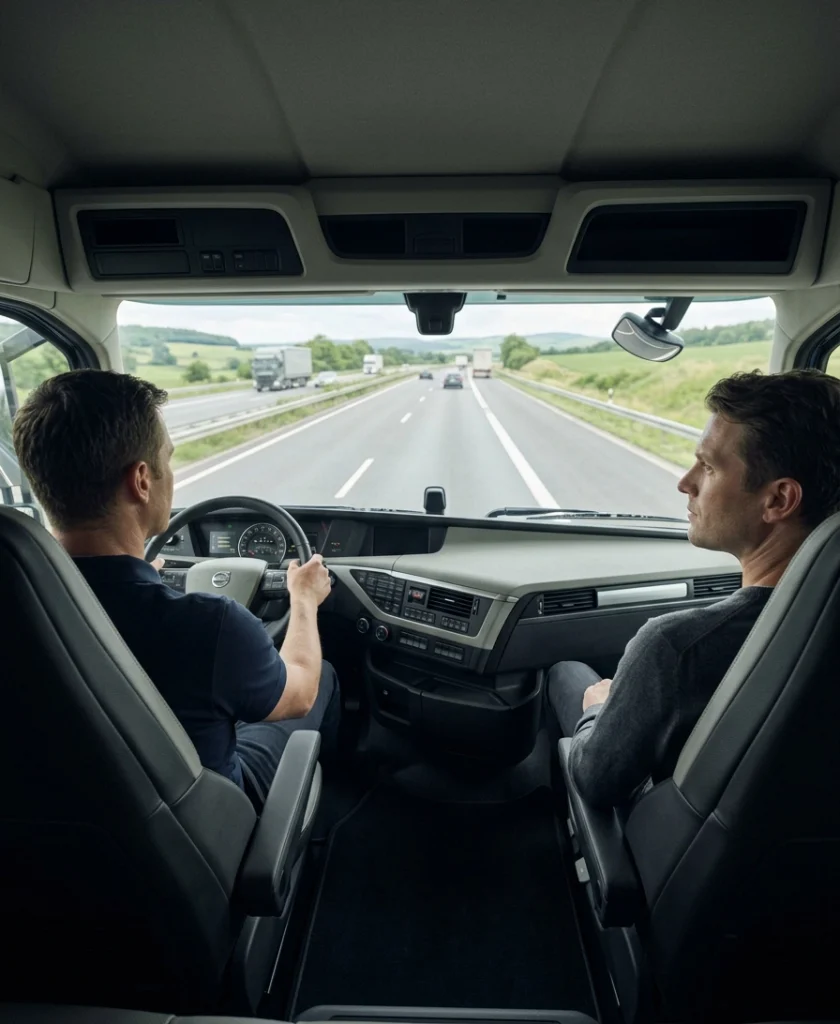
Correct use of smart cards is your legal armor. A digital Tachograph has two slots.

According to European directives (multi-manning tachograph rules), the time the second driver spends in the passenger seat (in ‘Availability’ mode) counts as a 45-minute break for them. This means the crew does not need to stop in a parking lot for 45 minutes. It is enough to simply stop for 5 minutes, swap places, switch cards — and continue driving.
Transport police inspectors are well aware of how crews are caught. If you violate the rules below, the tachograph multi-manning will be annulled, and your shift will be calculated according to solo driver rules (which will lead to a huge fine for exceeding working hours).
The second driver is not obliged to start the shift at the exact same second as the first. However, they must get into the cabin and insert their card into Slot No. 2 within 1 hour after the first driver’s shift begins. If the co-driver joins after 1.5 hours, this trip is not legally considered a two-driver crew operation.
This is the most common and most expensive mistake made by newcomers. Many think: ‘While my co-driver is driving, I’ll sleep in the bunk, and it will count as 9 hours of daily rest.’
Cards must remain in the Tachograph throughout the entire shift (21 hours). If the co-driver removes their card during unloading to go to a shop, and the first driver drives even 10 meters around the warehouse during this time, the crew is ‘disbanded’.
While newcomers undergo their internship as part of a two-driver crew, their Legalization process is simultaneously initiated. To even sit in the cabin as a second driver, your basic documents for a driver in Europe must be in order.
For a long-haul truck driver, the ability to travel freely across the EU is critically important. If the visa has expired, and the Residence card in Poland has not yet been issued (only a red stamp in the passport), leaving Poland is illegal.
To solve this problem, the government is announcing new Residence permit in Poland rules aimed at digitizing the e-Pobyt portal. The main goal of the reform is Residence permit in Poland within 60 days.
Important Legal Clarification: As of the preparation of this material, this period is a planned target, not a working guarantee. The speed at which obtaining a Residence permit in Poland will be completed still depends on the workload of the Voivodeship Office and the correctness of the submitted documents. Residence permit for drivers in Poland is issued based on Appendix No. 1 (Załącznik nr 1) from the employer. Until the changes come into full effect, the exact conditions and actual timelines should be verified before submitting documents.
Your Residence card for a driver job is a responsibility for both you and your company. Ideal work without Tachograph fines increases the chances of hassle-free Legalization.
Two drivers sharing a Tachograph share not only working time but also daily life.

It’s possible to understand Tachograph modes from online articles, but in practice, when there’s a queue beeping behind you at the warehouse, newcomers often get confused and mix up the slots.
At the driving school and training center ‘Code 95 at Marka’ (StarTruck), we do not allow such situations. In our courses, Legalization for drivers in Poland and practical skills go hand in hand.
A two-driver crew is an effective logistics tool and an excellent school for a novice driver. Understanding how the two-driver crew Tachograph works, timely swapping of smart cards in slots, and adhering to the 21-hour shift guarantee you calm work without stress during BALM inspections. Study the material, keep your professional and migration documents up-to-date, and European roads will become a comfortable place for you to earn a living.
Yes, if the truck is parked in a legal parking area, the engine is off, and the cabin is equipped with sleeping berths (bunks) for each driver. However, regular weekly rest (45 hours) in the cabin is prohibited in many EU countries (e.g., France and Germany).
If the co-driver is physically unable to drive, you must remove their card from Slot No. 2. From this moment, the crew is disbanded, and you continue to work strictly according to solo driver rules (maximum 13/15 hours of shift within a 24-hour period). Be sure to make a printout from the Tachograph and describe the reason for the change in crew composition.
Yes. If you are officially employed during the internship (you have a signed Umowa o pracę or Umowa zlecenie), and ZUS taxes are paid from your salary, this time is considered fully legal work and is a basis for obtaining a Residence permit.
Follow us on social media
[qsm quiz=”1″]